The History of the Barrier Beaches.
The Barrier Beaches consist of six communities, each with their own rich history. Read more about how these communities came to be.
We are always adding to our historical pages and references. If you have any historical images or information to share about the Barrier Beach communities, please contact us!
History of Barrier Island Beaches
Under Authority of Town of Huntington 1663-1872
1663 – People were actually grazing livestock on the Barrier Island this early date. Records of Agricultural Supervisor ordered residents to stop their swine from trampling the salt meadows and enforced forfeiture off seven shillings for each load of salt hay mowed.
April 1671 – Huntington also placed a fine of five pounds for everyone found on Marshes on the Island in September. These Marshes were prized by early settlers up until the 1800’s.
April 4, 1785 – The first post-Revolutionary lease was made to Joshua Ketchum. However, private homes were never allowed on the island even though the shelters for watchman guarding the valuable oyster beds were permitted.
1845 – Leased a piece of land to John L. Korthwright.
1866 – Records show another lease to Timothy S. Carll for 12 years at $50 per year for the privilege of planting oysters and erecting a house for person to live and protect said privilege. Other de-facto shelters existed before 1845.
Town of Babylon Founded in 1872 with authority over Barrier Beaches
1872 – Babylon Town Board minutes indicated that no hay cutting or cattle grazing was allowed for 6 years. The town hired grass cutters and auctions were held on Babylon’s docks. They also did away with leases of lands under water since rights of lease of navigable waters is doubted.
1878 – A lease arrangement was made between Babylon and Islip on April 2nd to share each other’s waters in the Great South Bay for oyster planting purposes. Within weeks of this agreement, the first lease to build a hut was granted to Erastus Tooker. On November 7, 1878 Charles J. Duryea, President of Babylon Town Board as authorized to sign a 21 year on Oak Island Beach for 18 Babylon residents with express intention that lease holders could utilize lots for recreational and residential purposes. This was known as the Oyster Planters and Businessman’s Association of Babylon.
1879 – On August 13th Babylon’s Trustees also authorized leases for members of Oyster Planters Association of Amityville for lots on Oak Island. The public was allowed access to all islands except in July and August. The only exception was men from the U.S. Lifesaving Station.
Barrier Beach History of the Barrier Island Leases
While there was actually an active Oak Beach Civic Association in the 1940’s that dealt primarily with issues of water quality in and around Oak Beach, the modern version was formed around 1975 by three women: Jane Wilson and Mae Scalia of Oak Beach and Katherine Zutty of the Oak Island Beach Association. Initially, the purpose of the organization was to deal with the serious erosion problem that was occurring along the Inlet shoreline of both Oak Beach communities. Many thought the reason for this increased erosion was the over-dredging of the Fire Island Inlet by the US Army Corps of Engineers during this time period, an opinion later supported by two independent engineering studies. Looking back, most believe it was the lobbying efforts of this new organization that eventually resulted in the Army Corps redesigning their dredge channel area and relocating it in such a way that it no longer threatened the Oak Beach shoreline.
Nevertheless, from the very beginning, the early By-Laws stated that membership in the organization would be open “to any leaseholder in all of the six Babylon barrier beach communities: Oak Beach, Oak Island Beach Association, Captree, Oak Island (Great South Bay Isles Association), Gilgo and West Gilgo Beach Association.”
The OBCA quickly became a vehicle for concerned Oak Beach residents to deal with the emerging problems that arose from the growing popularity of the Oak Beach Inn. The ensuing battle would go on for several more decades.
Perhaps the most significant work from this era, however, came about as a result of an offshoot of the OBCA: the Ad Hoc Outer Beach Committee that dealt throughout the 1980’s with negotiating the extension of beach leases that were scheduled to expire around the turn of the century. Two individuals from each of the six communities worked together for much of that decade to hammer out details with successive Babylon Town Boards. While Oak Island ended up working towards their own separate resolution, the entire matter was finally resolved in September of 1990 with the Town of Babylon reissuing new leases for each community that would run to the year 2050.
Although the lease matter was resolved with the Town, a separate issue that quickly arose was a lawsuit brought by NY State Secretary of State Gail Schaefer in November of 1990 to cancel the new leases on environmental grounds. Once again OBCA and the Ad Hoc Committee worked with Town and State officials, this time to persuade the State to call off the lawsuit. This was achieved, on the condition that the Town and beach residents undertake an “Environmental Study of the Barrier and Bay Island Communities”. This document, the so called “Cashin Study” costing $100,000, half of which was paid for by the residents with the other half by the Town, showed in sum that the “the six subject communities have not had large scale, adverse impacts on the barrier and bay island environment” and remains important to this day in guiding Town policy regarding the beach communities.
Following the lease renewal and law suit of the early nineties a number of issues and activities arose with which the Civic Association became involved.
One such group of activities that developed and continue to this day are the various social activities throughout the year. With the declining activity of the Oak Island Beach Yacht Club in the late 1980’s, these gatherings harken back to earlier traditions of neighborliness and fellowship, not to mention a festive party atmosphere! A spring cocktail party serves to kick off the summer season, followed in July by a Summer Parade, Barbecue and Raffle; the proceeds of which become annual donations of several hundred dollars to such organizations as the Babylon Community Scholarship Fund, Mayor E. Donald Conroy Scholarship Fund, The Babylon Fire Department, Ty’s Reef and others. (With the Oak Beach Community Center temporarily off limits pending reconstruction, the summer of 2014 found the Civic Association teaming up with Save the Beaches Fund to host a successful, combined barbecue held at West Gilgo) The last event of the year has been a Christmas Tree Lighting and Holiday Party hosted jointly by OBCA and OIBA, although postponed for two years because of the Community Center unavailability.
In 1996, a By-Laws Committee drafted a new Constitution and By-Laws to make them more relevant to the times. It was adopted and has since been amended three times in order to bring them, once again, up to date.
As a new century began, an acceptable resolution to the decades-long difficulties with the Oak Beach Inn began to take shape, but it would not be finalized until the conclusion of a complicated and somewhat stressful process over a period of two years. At one point the Inn, the park at Oak Beach and even some state land was on the verge of being sold to a developer for the construction of two large four story condominiums on the site. The possible intrusion of such a large facility totally out of character and in the midst of the neighboring Oak Beach communities was objectionable, to say the least, to the residents living there. Opposition organized by the Civic Association helped to fend off the sale until Suffolk County, largely through the efforts of Suffolk County Legislator David Bishop, purchased the land and tasked the Town with developing a park.
Unfortunately, what soon followed was a lawsuit brought by the developer against eight individuals and two associations for financial loss as a result of not being able to build the condominiums. All ended well, however, after residents’ lawyers filed a well-crafted counter suit and, in a spirit of support and cooperation, their legal fees were paid by an STBF fund for just such contingencies.
Subsequent to these events, the Town formed an Oak Beach Task force charged with conceiving a plan for park development. With OBCA participation initially in this process, the as yet undeveloped park remains an issue of concern and one that will continue to be monitored in the future by the Civic Association.
It was around this time that OBCA created a fast and cost effective method of maintaining communication with members through the establishment of a civic email list, currently reaching over 270 addresses. Later, a website was developed serving a variety of functions including a list of “service providers” to the barrier beach communities.
Following a fire in Oak Beach in 2004, the Civic Association worked with Town and County officials on measures to improve response time for emergency vehicles. In addition, in the case of the three communities comprising the East Beach Fire District (Oak Beach, Oak Island Beach Association and Captree) the Civic Association organized the installation of twenty new fire wells.
The care and maintenance of the Oak Beach Community Center was handed over to the Civic Association by Don and Suzie Hendricks around 2005, shortly before their passing. Owned by the Town, the building’s foundation had long been neglected and suffered some damage after Hurricanes Irene and Sandy. Most recently, however, with support from TOB and especially, Councilman Tony Martinez, funding is being appropriated for an ambitious reconstruction project.
In the wake of Hurricane Sandy in October of 2012 and a host of storm recovery efforts, Governor Cuomo instituted as part of his NY Rising campaign the creation of a Community Reconstruction Program and, locally, a committee to design projects to better prepare our communities for future storm events. The West Gilgo to Captree CRP Committee, comprised of State officials, planning consultants, engineers and residents from each of the six Babylon beach communities worked for over nine months to develop a plan with nine featured projects that would be funded by $3 million through the federal HUD CDBG – DR Program.
While the fate of those featured projects remains uncertain at this time, what developed as a result of the committee process was a spirit of cooperation among resident members and an opportunity to learn more about our neighboring communities. And, with an eye towards the continued welfare of those communities what soon followed was the suggestion to formally recognize and build on the original intent of the organization; namely to be a Barrier Beach Civic Association. Most would agree that while each of our communities has individual characteristics, the beach communities share a variety of common interests and issues owing not only to their location but their status as tenants of the Town of Babylon. Looking to the future, most would also agree it makes sense to have an organization which can respond to the needs of individual communities as well as the beach communities as a whole.
History of Gilgo Beach
By Mike Cavanaugh, Gilgo Beach Gilgo Beach History
The Gilgo Beach story begins with one of 32 Life Saving Stations situated along Long Island’s south shore from Coney Island to Montauk. Life Saving Station #27, established just east of the Gilgo Inlet in the early 1850’s was originally known as “Oak Island West End” station until June 1, 1883 when its name was changed to “Station Gilgo.” The predecessor to today’s Gilgo, a cottage colony and resort called Hemlock Beach, grew up around this station.
The area had caught people’s attention by 1879 when the Town of Babylon leased a portion of Hemlock to the Amityville Oyster Club. The area grew quickly from there and by the early 1880’s Hemlock Beach was becoming a popular getaway for day trippers, such that the Fourth of July in 1884 brought over 200 people there. The main attraction was Vaan Nostrand Brothers’ Hemlock Pavillion. Occupying an old building previously utilized as part of the life-saving station, it opened sometime in the early 1880’s and was accessible by private boat or a sailing ferry service run by Frank E. Wicks. By 1883 a cottage community was also emerging, the first a 13’x24’ structure built by Stephen R. Williams.
Around 1900 the ferry service was transitioning from sail to steamer with the first two steamers named “Columbia (operated by Wicks) and Adele (operated by Charles Sprague). Wicks would later add the “Atlantic” in 1904. At the time a round trip cost 25cents for adults and 15 cents for children.
A major setback occurred in the winter of 1904/1905 when a January storm opened a new inlet just west of the life-saving station, right in the midst of the cottage community. Over the next two years, with the inlet’s location constantly in flux, several cottages were lost to the ocean and several more, including the life-saving station had to be moved on short notice.
Hemlock survived and over the next five years with transportation on the mainland improving, the resort’s popularity increased as it became more accessible to the residents of the north shore and mid-island. So much so that in 1913 a 50-person hotel, dance hall, restaurant and bar were being planned. At the same time the cottage community was growing as well with the Babylon supervisors reporting a total of 28 houses at Hemlock in 1913.
The optimism was abruptly cut short when a January, 1914 storm signaled the beginning of the end for Hemlock as a summer resort. The storm washed away several lots and left others partially submerged and served as the catalyst for a move west, down the beach to Gilgo. Later that year another storm, this one in December provided the knock-out blow, toppling the life-saving station and washing away several of its out buildings. Within a week lots at Gilgo were in demand and 14 of the surviving houses were on the move to Gilgo.
The life-saving station remained operational for another year while the crew quartered in two surviving cottages but was formally abandoned in February, 1916.
Meanwhile down the beach at Gilgo as late as 1911 there were a total of only 3 buildings, a number that would change exponentially with the exodus from Hemlock. In early 1915, in addition to the 14 relocated houses Gilgo featured a bathing pavilion and hotel that had opened in July, 1914. Boardwalks had been established (some relocated from Hemlock) with the colony comprised of two east-west boardwalks named Gilgo and Coyler Avenues and three boardwalks running north-south named Rhoda Place, Steinbuck Place and Delancey Road, all of which dead-ended on the beach. New lease holders began building such that by 1920 the number of cottages was approaching 50.
Not just a cottage community, by 1916 a Brooklyn Daily Eagle story made it clear that Gilgo had replaced Hemlock as a south shore resort.
Gilgo Beach, the new resort across the Great South Bay from Amityville is enjoying a banner season. The high tide will come this weekend. Every cottage will be occupied and the Gilgo Hotel reports a large number of reservations. Surf and sill water bathing continues popular. Many weakfish have been caught in the surf and snappers are plentiful in the bay.
The hotel is a popular social center. Manager Steinbuck, and his assistant, Fred Brown, have provided very good music and a good dance floor, and the place is the rendezvous for many private boat parties.
The 1920’s were not kind to Gilgo due to funding issues and two mid-1920’s storms, one in August, 1924 and the other February, 1925 all of which contributed in reducing the number of cottages from nearly 50 in 1920 to 28 by the late 1920’s. It was around this time that plans for the extension of Ocean Parkway were in the works; plans that would ultimately transform Gilgo into its present configuration.
On April 3,1928 the Town of Babylon by a vote of 1,063 to 988 voted in favor of turning over to the State the land necessary to extend Ocean Parkway from Jones Beach east toward Captree. Of the 28 Gilgo houses eight were in the direct path of the parkway while twenty were located south of the parkway. Since it was also decided that no houses would be permitted south of the parkway, this meant that the entire Gilgo colony needed to be moved or demolished and a new location north of the parkway and just east of a new canal was designated. The new location for the cottages was certainly today’s Cottage Walk and the new canal was the one currently occupied by today’s town dock.
Ultimately just 22 of the cottages were moved under a contract with Julius Auserehl who moved the entire colony in 19 days at a cost of $18,750. Construction of the Parkway ultimately put the pavilion out of business when its owner couldn’t resolve a dispute with the State.
The Gilgo section of Ocean Parkway opened on September 10, 1931 and with cottagers now able to reach Gilgo by car the Town was forced to establish a parking area for residents as well as beach goers. Up to that point cottagers had been parking on the unopened/unfinished roadway. Originally 80’ by 40’ the lot could accommodate up to 50 cars. It was expanded for the first time in 1933 and certainly many times since.
The decade of the 1930’s continued to bring changes to Gilgo many of which are still with us today including parking fees (the Town earned $768 in 1932), bay constables (in 1933, to see that bathing rules are adhered to) and electricity (in 1935/36). In 1934 Arthur K. Bennett of Amityville submitted an application to build a refreshment stand at Gilgo. Zoning changes were subsequently approved and the seeds of the Gilgo Beach Inn were sown. The Inn officially opened the next year in 1935, and has been locally owned for much if not all of its 90-year history. The Hilbert family acquired it in 1960 and it was run by James Hilbert and later, sons Eddie and Robert, up until 2015 when it was acquired by Paul McDuffe and Steve Stratigos.
Plans for a Coast Guard Station to replace the Jones Beach, High Hill and Oak Beach life-saving stations were announced in 1932. Located on the beach just east of Gilgo, it opened in June, 1933. The station’s boat basin was dredged on the bay side and remains to this day, now locally referred to as “Coast Guard Cove.” The station itself was decommissioned in the late 1940’s and by 1950 was serving as a catering hall for the Long Island State Park Commission. Today, rubble from the station can still be found along the beach.
More direct boat access to Gilgo from the mainland was also achieved in the 1930’s with the dredging of what is known today as the “Amityville Cut.” Prior to the “Cut” the route from Amityville to Gilgo was roundabout at best.
It wasn’t until the late 1940’s/early 1950’s that most of the houses situated west of the Gilgo Beach Inn on Broadway were built at which time Gilgo pretty much took on the look of today.
The Story of Oak Island Beach By Ed Meade
Walking Through Time: The Boardwalks That Shaped Oak Beach by Jim Schappert
Oak Island Beach Association
COMING SOON! Please reach out to us to share history of Oak Island Beach Association!
History of Oak Island
With residences first established in 1879, Oak Island is a small boat-only access community with seasonal off the grid residences connected by a common boardwalk along the southern edge of the island. The properties are part of a land lease from the Town of Babylon through the Great South Bay Island Association.
Late 1800’s:
1879 – The first privately owned cottage on Babylon’s Bay Island was built by Henry Livingston and was called Little Rest.
1882 – 1883 – Second house was built by Benjamin Field.
1884 – Charles Searle built the 3rd house.
Alanso Weeks, James Cooper, Jeramiah Robbins and Frederick Thorpe houses soon joined their three friends listed above.
History of West Gilgo Beach, New York
Origins: High Hill Beach (1900–1939)
West Gilgo Beach traces its roots to High Hill Beach, a summer colony that existed from around 1900 to 1939. Located just east of today’s Jones Beach Field 6 along the eastern rim of Zachs Bay, High Hill was originally a quiet seaside community of about 20 to 30 cottages, eventually expanding to nearly 100 by the 1920s. The settlement featured a hotel-casino (Sportsmen’s Hotel, later Savage’s Pavilion), a store, boarding house, post office, and life-saving station.
Access to High Hill was originally only by ferry from Bellmore or Seaford, a 40-minute trip through the bays. The community had no plumbing or electricity—residents used kerosene lamps, wells for water, and outhouses. The central social hub was a large wooden pavilion, where families gathered for food, music, and dancing. Memories from longtime residents describe the area as a simple, communal seaside retreat before the development of the state park system.
⸻
The Creation of Jones Beach and Relocation (1929–1940)
When Robert Moses spearheaded the creation of Jones Beach State Park, the land under High Hill was absorbed by the state. Residents were given 11 years (1929–1940) to vacate or relocate. Most chose to move their homes rather than abandon them.
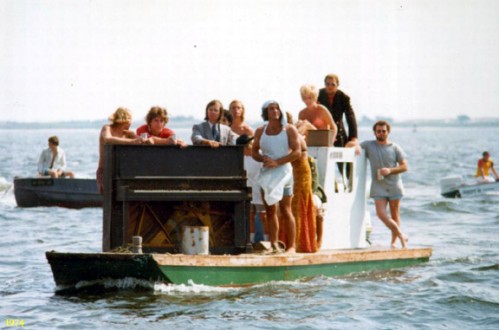
By 1940, about 70 cottages were physically moved—some by barge along the State Boat Channel—to a newly organized community: West Gilgo Beach, located just over the Suffolk County line in the Town of Babylon. Others relocated to Tobay or Oak Beach, or saw their homes demolished.
The West Gilgo Beach Association was formally incorporated in 1939, establishing a cooperative model for property leases with the Town of Babylon. Early leases cost $100 per year for 12 years, renewable upon good maintenance.
⸻
Development of West Gilgo Beach (1940–Present)
West Gilgo was laid out as a gated beach hamlet, consisting largely of houses originally from High Hill. Its residents, many from the same families, maintained the close-knit community spirit of their former home. A 1940 Nassau County Review Star article described “some 70 little summer homes being picked up bodily and taken by truck or barge” to the new site.
The area weathered significant storms, including the 1938 “Long Island Express” hurricane and the 1944 Great Atlantic Hurricane, which reshaped much of the barrier beach landscape. Subsequent erosion control and dune restoration projects in the 1940s and 1950s reinforced the shoreline and infrastructure around Gilgo and Oak Beach.
Today, West Gilgo Beach remains a private, resident-managed community, preserving the architectural and cultural legacy of the original High Hill cottages. Some homes still exhibit early 20th-century design features, and the community continues to balance preservation with environmental stewardship on the shifting barrier island.
⸻
Key Sources Referenced
• Clyde’s Guides: High Hill Beach, LI NY
• High Hill Striper Club: What About the Name?
• Seaford Blog: High Hill Beach
• Long Island Traditions: Eastern Nassau Barrier Beach Communities
• Levonius Family Archive: High Hill Beach Photos
• Wikipedia: West Gilgo Beach, NY
• Wikipedia: Jones Beach State Park
• Newsday Archive: Living the Good Life by the Sea (1999)
• Wikimapia: Approximate Location of High Hill Beach
Mission